Channel Coding in Communication Networks: From Theory to Turbocodes
The implementation of error correction on board a satellite, a remote spacecraft, in computer memory, on optical or magnetic discs, in CD readers, is carried using electronic circuits. These circuits primarily use shift registers, carrying out multiplications or divisions of polynomials with coefficients in
or
.
In this section, circuits are drawn without taking traditional standards into account, as far as logical gates and oscillation are concerned. We will not represent connections with the clock.
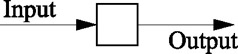
There is the flip-flop, represented as follows, which contains a binary value. This flip-flop is under the control of a clock. With each beat (or signal) of this clock the flip-flop transmits the value that it contained and receives the value presented at input. A flip-flop has an input and an output (see Figure 2.2).
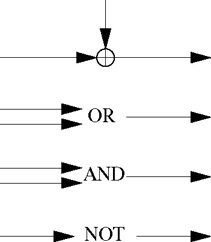
There are also logical gates, "OR", "AND", "exclusive OR" represented as follows (see Figure 2.3).
These logical gates are not under the control of the clock.
If two signals follow different sets of logical gates, the difference in propagation time is one of the limitations of certain algorithms.
In transmissions binary vectors often represent binary polynomials. These always circulate from the coefficient with the highest degree to the constant coefficient. When a polynomial enters a register it enters starting with the monomial coefficient of the highest degree. For example, if we take the polynomial 1 + X + X