The Chemistry and Physics of Coatings, Second Edition

Chapter 6: Binders for Conventional Coatings

A.R. MARRION

6.1 BINDERS AS POLYMERS

Of the four components of a typical coating - binders, fillers, additives and thinners - the character of the binder has the greatest impact on the performance of the coating, and defines its properties. Binders are almost invariably polymeric, if not at the point of application, then certainly when the film is 'cured' and ready to see service. A number of additives are also polymeric materials that exert a significant influence on the binder system.

Polymers are large molecules, usually constructed of one or more repeating units or 'mers' derived from monomers. Their chemistry is extremely diverse (as we shall see) but their character is also heavily dependent on their molecular weight and architecture.

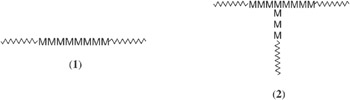
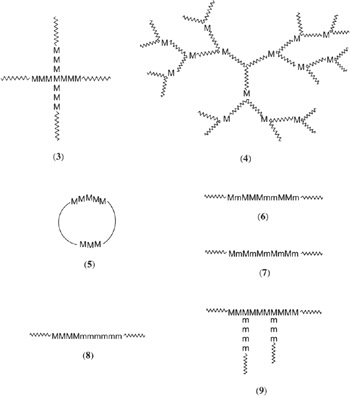
Representing a monomer as M, its tractable polymers can be straight chains ( 1), branched ( 2), radiate ( 3) (stars if the number of branches exceeds about four), hyperbranched (where the branches have branches) ( 4) or even cyclic ( 5). When a second monomer m is introduced it is possible to envisage random ( 6), alternating ( 7), blocky ( 8) or grafted ( 9) copolymers.

The molecular weights of polymers can vary from a few thousand to several million and it is often more convenient to think in terms of degree of polymerisation (DP), i.e. the number of monomer residues.

No known polymer system is composed entirely of molecules of identical molecular weight. The overall molecular weight...

UNLIMITED FREE
ACCESS
TO THE WORLD'S BEST IDEAS

SUBMIT
Already a GlobalSpec user? Log in.

This is embarrasing...

An error occurred while processing the form. Please try again in a few minutes.

Customize Your GlobalSpec Experience

Category: Monomers, Intermediates, and Base Polymers
Finish!
Privacy Policy

This is embarrasing...

An error occurred while processing the form. Please try again in a few minutes.