Chlorosulfonic Acid: A Versatile Reagent
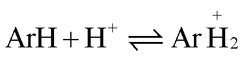
Aromatic hydrocarbons are readily protonated in strongly acidic media, e.g. sulfuric and Chlorosulfonic acid (Equation 1).
| (1) | |
The protonated form of the hydrocarbon is considerably less reactive towards electrophilic substitution than the unprotonated substrate.
The early work on the sulfonation and chlorosulfonation of aromatic compounds has been extensively documented in Suter's book1 and for aromatic hydrocarbons and their halogen derivatives by Suter and Weston.2 More recently, the chlorosulfonation of aromatic and heteroaromatic systems was reviewed by Bassin, Cremlyn and Swinbourne.3 Details of kinetic and mechanistic studies on sulfonation and chlorosulfonation of aromatic hydrocarbons and other derivatives have been described in Chapter 2. Chlorosulfonic acid is a very active sulfonating agent and when benzene is added to an excess of the reagent at room temperature, benzenesulfonyl chloride is formed (> 70%) with only a trace of diphenyl sulfone. 1 4 On the other hand, when an excess of benzene is present, the major products are diphenyl sulfone and benzenesulfonic acid.1 ,4 ,5
Early studies of the reaction of chlorosulfonic acid on benzene were carried out by Armstrong6 who obtained a mixture of benzenesulfonic acid, diphenyl sulfone and benzenesulfonyl chloride. When benzene is heated with a large excess of chlorosulfonic acid (ten equivalents) at 150 160 C for 2 hours, the major product was benzene m-disulfonyl chloride (28%), together with small amounts of dichlorosulfonyldiphenyl sulfone and benzene p-disulfonyl chloride.2 ,7 ,8 Several patents 9 15