Chlorosulfonic Acid: A Versatile Reagent
The appendix contains a selection of the most recent references to chlorosulfonic acid together with details of the relevant chapters in the main text for cross-reference. The literature has been covered up to December 2001.
T. Salmi, P. Maki-Arvela, E. Paatero and R. Bygginskacka, J. Chem. Technol. Biotechnol., 2000, 75(1), 89; Chem. Abs., 132, 23667.
The selective ?-chlorination of propanoic acid to 2-chloro- and 2,2-dichloropropanoic acid at 80 130 C in the presence of chlorosulfonic and dichloroethanoic acid as catalysts and oxygen as the radical scavenger was examined. The results confirmed previous studies (Chapter 5, Section 5.6), indicating that the intermediate was propanoyl chloride formed from propanoic acid and chlorosulfonic acid by acid-catalysed enolization and substitution of the hydroxyl group by chlorine.
K. Matsuda, K. Hara and M. Akamatsu, PCT Int. Appl., WO 001478 (2000); Chem. Abs., 132, 207843.
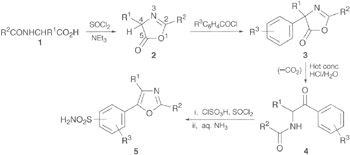
An N-acylamino acid ( 1) is reacted with thionyl chloride yielding the oxazolone ( 2), which by treatment with an aroyl chloride gave ( 3). The latter compound was hydrolysed and decarboxylated to yield ( 4), which reacted with chlorosulfonic acid-thionyl chloride to give the sulfonyl chloride, and subsequent reaction with ammonia afforded the sulfonamide ( 5) (Scheme 1).
As an example of the procedure, DL- N-acetyl-2-cyclohexylglycine, by reaction with 3-fluorobenzoyl chloride in the second step, was converted into 5-(4-sulfamoyl-3-fluorophenyl)-4-cyclohexyl-2-methyloxazole (82%...