Civil Engineering: Building Structures Review
Filled with solved examples and problems, and key concepts and equations, this comprehensive review guide is for civil engineers who want to prepare for the building structures topics of the PE exam.
Prestressed concrete members must be designed to ensure an adequate degree of safety and serviceability at the three main construction stages. These stages are:
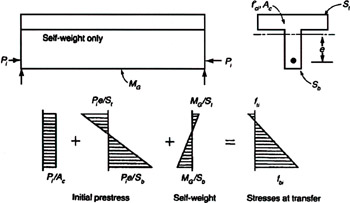
The transfer limit stage, when the prestressing force is applied to the concrete section. The immediate prestress losses from friction, elastic deformation of the concrete, and anchor set have occurred, giving an initial prestressing force of P i. Since the initial prestress causes the concrete member to arch, the self-weight of the member produces the bending moment M G.
The serviceability limit stage, when all along-term prestress losses from creep, shrinkage, and relaxation have occurred, giving a final effective prestressing force of P e. The superimposed dead and live loads produce bending moments of M D and M L, respectively.
The ultimate limit stage, when the design strength of the member is sufficient to support the factored loads.
Figure 10 illustrates stress conditions at transfer. The limiting concrete stresses at transfer are specified in ACI Section 18.4.1 as:
Compressive stress, 0.06 f' ci.
Tensile stress (at ends of simply supported beams), 6 ? f' ci
Tensile stress (at other locations), 3 ? f' ci
Where these tensile stresses are exceeded, auxiliary reinforcement at a stress of 0.6 f y must be provided to resist the total tensile force in the concrete. The stress in the prestressing tendon immediately after transfer must not exceed the lesser of...

 TABLE OF CONTENTS