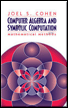
Computer Algebra and Symbolic Computation: Mathematical Methods
The chapter is concerned with the numerical objects that arise in computer algebra including the integers, the rational numbers, and other classes of numerical expressions. In Section 2.1 we discuss the basic mathematical properties of the integers and describe some algorithms that are important for computer algebra. Section 2.2 is concerned with the manipulation of rational numbers. We define a standard form for a rational number and describe an algorithm that evaluates involved arithmetic expressions with integers and fractions to a rational number in standard form. In Section 2.3 we introduce the concept of a field, which is a mathematical system with axioms that describe in a general way the algebraic properties of the rational numbers and other classes of expressions that arise in computer algebra. We give a number of examples of fields and show that many transformations that are routinely used in the manipulation of mathematical expressions are logical consequences of the field axioms.
In this section we describe some mathematical and computational properties of the integers
The following theorem gives the basic division property of the integers. [1]
Theorem 2.1. For integers a and b ?0, there are unique integers q and r such that
and
The integer q is the quotient and is represented by the operator iquot (a, b) (for integer quotient). The integer r is the remainder and is represented by irem (a, b).
In Theorem 2.1, the quotient and remainder are chosen so that r