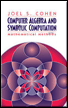
Computer Algebra and Symbolic Computation: Mathematical Methods
Chapter 6: Multivariate Polynomials

Most symbolic computation involves mathematical expressions that contain more than one symbol or generalized variable. In order to manipulate these expressions, we must extend the concepts and algorithms described in Chapter 4 to polynomials with several variables. This generalization is the subject of this chapter. It includes a description of coefficient domains and a recursive view of multivariate polynomials (Section 6.1), versions of polynomial division and expansion (Section 6.2), greatest common divisor algorithms (Section 6.3), and the extended Euclidean algorithm (Section 6.3).

6.1 Multivariate Polynomials and Integral Domains

A multivariate polynomial u in the set of distinct symbols { x 1, x 2, , x p} is a finite sum with (one or more) monomial terms of the form


where the coefficient c is in a coefficient domain K and the exponents n j are non-negative integers. (The axioms for K (which may not be a field) are given in Definition 6.2 below.) The notation K[ x 1, x 2, , x p] represents the set of polynomials in the symbols x 1, x 2, , x p with coefficients in K. For example, Z[ x, y] represents all polynomials in x and y with coefficients that are integers.

A particularly important instance when K is not a field has to do with the recursive representation of multivariate polynomials. For example, let Q[ x,

UNLIMITED FREE
ACCESS
TO THE WORLD'S BEST IDEAS

SUBMIT
Already a GlobalSpec user? Log in.

This is embarrasing...

An error occurred while processing the form. Please try again in a few minutes.

Customize Your GlobalSpec Experience

Category: IC Electronic Filters
Finish!
Privacy Policy

This is embarrasing...

An error occurred while processing the form. Please try again in a few minutes.