The 3rd Technical Symposium on Computer Applications of Fire Protection Engineering

The FDS computer code is described in a number of references. The FDS Technical Reference Guide [2] includes a good discussion of the theory and limitations of the code. There is no need to provide a comprehensive discussion of the FDS code in this paper, but a brief overview of the model and some of the limitations will be presented.
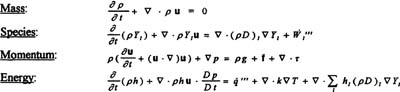
FDS solves the Navier-Stokes equations for the case of low Mach Numbers. As described in [2], the governing equations, before simplification, are the equations for conservation of mass, species, momentum and energy:
where ? is mass density, t is time, u is velocity (bold indicates vector quantities), Y 1 the mass fraction of species 1,
is the generation rate of species 1 per unit volume, p is pressure, g is gravitational acceleration, ? is the shear stress, h is enthalpy,
is the energy generation rate per unit volume, k is conductivity and D is diffusivity. The equation of state used for problem closure is the ideal gas law with a term added to account for the atmospheric density gradient and a flow induced perturbation pressure term. These equations are simplified in a number of ways consistent with the low Mach number assumption. These simplifications are made to reduce the computational time and thereby result in a more practical engineering tool.
A second order central differencing scheme is used in the numerical solution. The FDS model has two solution...