Advanced Methods and Tools for ECG Data Analysis

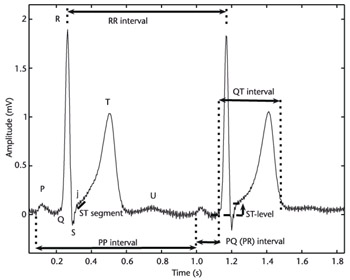
Clinical assessment of the ECG mostly relies on relatively simple measurements of the intrabeat timings and amplitudes. Averaging over several beats is common to either reduce noise or average out short-term beat-to-beat interval-related changes. The complex heart rate-related changes in the ECG morphology (such as QT hysteresis [4]) can themselves be indicative of problems. However, a clinician can extract enough diagnostic information to make a useful assessment of cardiac abnormality from just a few simple measurements.
| Feature | Normal Value | Normal Limit |
|---|---|---|
| P width | 110 ms | 20 ms |
| PQ/PR interval | 160 ms | 40 ms |
| QRS width | 100 ms | 20 ms |
| QTc interval | 400 ms | 40 ms |
| P amplitude | 0.15 mV | 0.05 mV |
| QRS height | 1.5 mV | 0.5 mV |
| ST level | 0 mV | 0.1 mV |
| T amplitude | 0.3 mV | 0.2 mV |
| Note: There is some variation between lead configurations. Heart rate, respiration patterns, drugs, gender, diseases, and ANS activity also change the values. QTc = ?QT where ? = |