Design Guide: Combustion Turbine Inlet Air Cooling Systems

Providing users with an understanding of the benefits and limitations, this guide assists in the successful design and implementation of a combustion turbine inlet air cooling system.
 TABLE OF CONTENTS
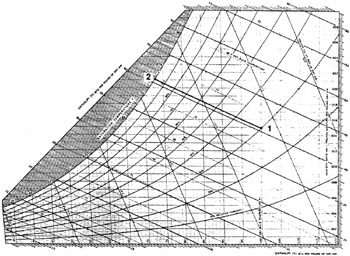
 The generation capacity of a combustion turbine is affected by altitude (atmospheric pressure), as the turbine rating must be corrected for altitude. The cooling processes are also affected by altitude. The examples given in Figure 10 are for sea level conditions; the psychrometric chart for 5000 ft (1524 m) altitude is shown in Figure 11. For example, the evaporative cooling effect would change from 74.3 F (23.5 C) temperature to approximately 73 F (22.8 C), shown as condition 2. The effect of altitude on cooling capacity, as shown, can be significant as in this example, where the cumulative effect may be great when considering the effect over year-long operation and year-after-year operation.