Design Guide: Combustion Turbine Inlet Air Cooling Systems
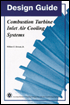
Providing users with an understanding of the benefits and limitations, this guide assists in the successful design and implementation of a combustion turbine inlet air cooling system.
 TABLE OF CONTENTS
 For any of the vapor compression refrigerating equipment configurations, heat must be rejected from the condenser component of the refrigerating system. Cooling is required to be supplied to the condenser to condense the refrigerant (condensing the high-pressure, high-temperature refrigerant vapor to a high-pressure, lower-temperature refrigerant liquid). Where there is an available, relatively inexpensive water supply, the typical equipment used to supply condenser cooling, via a water-to-refrigerant heal exchanger, is a wet cooling tower. The cooling tower circulates water to the heat exchanger, where the water absorbs heat from the condensing refrigerant and is then returned to the cooling tower where it falls through a media while subjected to a cross-flow or counterflow current of ambient air, forced or induced through the cooling tower by a fan. This process is essentially the same as the evaporative cooling process, except for the addition of external heat from the condenser, as the water exiting the cooling tower approaches the ambient wet-bulb temperature, typically within 5 F (2.8 C).
Other condenser cooling/heat rejection options include evaporative cooling, which is similar to the cooling tower process, except evaporating water is used directly to cool the condenser. Evaporative cooling allows the condenser to operate at slightly lower temperatures and higher efficiencies compared to cooling towers.
If water is not available for a cooling tower or an evaporative condenser, or if the cooling system operates on a minimal number of hours, heat rejection can be accomplished with ambient air using a finned coil condenser (air-cooled...