Design of Multi-Frequency CW Radars

Chapter 2: Radar Waveforms and Processing

2.1 RADAR SIGNALS

There is a need to choose the correct type of waveform based on a radar's mission. A correct decision in this respect is always a cost-effective decision. Broadly, radars can use pulsed waveforms or continuous waveforms (CW) with or without modulation. The quality of range or Doppler resolutions required, influence our choice of a suitable waveform or signal. We define low pass signals as signals that contain a significant frequency composition at a low-frequency band including DC. Those signals, which have a significant frequency composition around some frequency away from the origin are called band pass signals [1, 2]. We express this band pass signal as

(2.1)

where r( t) is the amplitude modulation or envelope, ? x( t) is the phase modulation, and f 0 is the carrier frequency. The frequency-modulated signal is defined by the rate of change of phase of the signal as

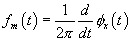
(2.2)

The instantaneous frequency is, therefore, given by

(2.3)

If f 0 is very large as compared to its bandwidth B, then we call it a narrowband signal.

In the case of narrowband modulation, we can represent the band pass signal of (2.1) as comprising two low pass signals known as quadrature components. We can then write (2.1) as

(2.4)

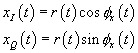
where

(2.5)

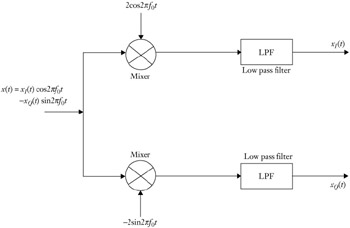
Equations (2.4) and (2.5) are in fact approximations to (2.1) for narrowband modulations. Figure 2-1 shows the extraction of these quadrature components from the band pass signal.


Figure 2-1: Extraction of quadrature...

UNLIMITED FREE
ACCESS
TO THE WORLD'S BEST IDEAS

SUBMIT
Already a GlobalSpec user? Log in.

This is embarrasing...

An error occurred while processing the form. Please try again in a few minutes.

Customize Your GlobalSpec Experience

Category: Signal Filters
Finish!
Privacy Policy

This is embarrasing...

An error occurred while processing the form. Please try again in a few minutes.