Developments and Applications in Solubility

RALF DOHRN, [1] RICARDA LEIBERICH [2] AND LJUDMILA FELE ILNIK [3]
The mathematical simulation of entire chemical production processes, or at least of crucial unit operations, allows an optimization of the process that can lead to very significant process improvements concerning costs, product quality and environmental aspects. To develop such a simulation model, a sound chemical and physical understanding of the crucial process steps, like reactions and separations, is needed. Physicochemical property data can be regarded as raw material of chemical process design,1 where the quality of the raw material might strongly affect the quality of the product. In addition to process design and process simulation, physicochemical property data play an increasing role in advanced process control models.
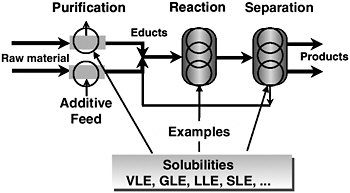
Figure 1 shows a simplified scheme of a chemical production process. Before the educts enter the reaction step, they are often purified or an additive is introduced. In both cases solubilities can be of importance. For the optimization of the chemical reaction, the knowledge of the solubilities of the components taking part in the chemical reaction is essential, including their dependence on temperature and pressure. After the reaction a separation of the products and by-products takes place and eventually a stream is recycled to the reactor. For difficult separations, small uncertainties in phase equilibrium data might have a huge impact on the design of the separation process.2
The knowledge and understanding of solubilities and phase equilibria is not...