Digital Communications: Satellite/Earth Station Engineering

Discrete phase modulation, known as M-ary phase-shift keying, is the most frequently used digital modulation technique. Biphase or binary PSK systems (BPSK) are considered to be the simplest form of phase-shift keying ( M=2). The modulated signal has two states, m 1 (t) and m 2 (t) given by
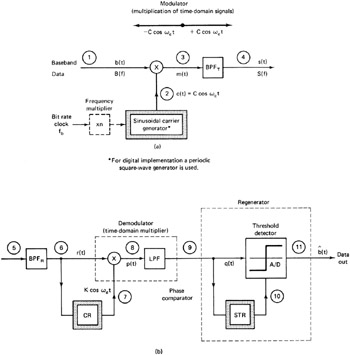
These signals can be generated by a system such as that shown in Fig. 4.4. The modulated signal is given by
If b(t) represents a synchronous random binary baseband signal having a bit rate, f b=1/ T b, and levels ?1 and +1 then equation (4.10) represents the antipodal (180 ) phase shifted signaling elements m 1 (t) and m 2 (t). Thus the information is contained in the phase of the modulated signal, that is,
where
For equiprobable NRZ baseband signals (+1 and ?1 volt normalized input voltages) time-domain multiplication is equivalent to double-sideband suppressed-carrier amplitude modulation (DSB-SC-AM) [see equation (4.10)]. The equivalent representation in equation (4.11) implies that a phase shift-keyed (PSK) signal is obtained. We should remember that time-domain multiplication may correspond to digitalphase modulation. In other words, an equivalence of digital DSB-SC-AM and PSK exists.
The baseband signal b(t), the unmodulated carrier wave c(t) , the modulated signal m(t), and the modulated-bandlimited...