Digital Communications: Satellite/Earth Station Engineering

4.4: OPTIMUM RECEIVER FOR BINARY DIGITAL MODULATION SYSTEMS

4.4 OPTIMUM RECEIVER FOR BINARY DIGITAL MODULATION SYSTEMS

In this section we derive the optimum receiver for binary digital transmission systems. A receiver is said to be optimum if it yields the minimum probability of error, P e . We assume that additive white Gaussian noise (AWGN) is the only system perturbance, and that the bandwidth is not constrained; that is, an infinite bandwidth inter symbol-interference-free transmission channel is available. The derivation that follows and the suggested implementation methods apply to baseband and to coherent binary modulated systems in general.

The relationship between the optimum receiver, a receiver that has (for a specified P e) the lowest carrier-to-noise requirement, and bandlimited receivers, which satisfy the Nyquist transmission criteria, is described in Section 4.5.

4.4.1 Model and Derivation of Binary Transmission System Performance

Let us assume that the input to the binary modulator is a random synchronous bit sequence {b k} with a bit rate f b=1 /T b . Let the modulator output during the kth bit interval depend solely on the kth bit b k . The modulator performs the following mapping:


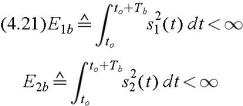
where s 1 (t) and s 2 (t) are two elementary waveforms having a duration of T b seconds, and having finite energy, that is,


A modulator and a possible binary demodulator are shown in Fig. 4.9. As we assumed intersymbol-interference-free transmission, it is sufficient to study the performance of this system...

UNLIMITED FREE
ACCESS
TO THE WORLD'S BEST IDEAS

SUBMIT
Already a GlobalSpec user? Log in.

This is embarrasing...

An error occurred while processing the form. Please try again in a few minutes.

Customize Your GlobalSpec Experience

Category: Bit Error Rate Testers
Finish!
Privacy Policy

This is embarrasing...

An error occurred while processing the form. Please try again in a few minutes.