Dimensioning and Tolerancing Handbook

Paul Drake
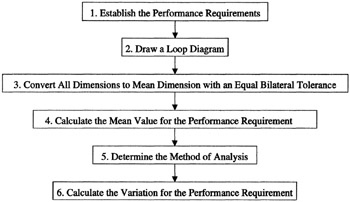
Tolerance analysis is the process of taking known tolerances and analyzing the combination of these tolerances at an assembly level. This chapter will define the process for analyzing tolerance stacks. It will show how to set up a loop diagram to determine a nominal performance/assembly value and four techniques to calculate variation from nominal.
The most important goal of this chapter is for the reader to understand the assumptions and risks that go along with each tolerance analysis method.
Fig. 9 1 describes the tolerance analysis process.
The first step in the process is to identify the requirements for the system. These are usually requirements that determine the performance and/or assembly of the system. The system requirements will, either directly, or indirectly, flow down requirements to the mechanical subassemblies. These requirements usually determine what needs to be analyzed. In general, a requirement that applies for most mechanical subassemblies is that parts must fit together. Fig. 9 2 shows a cross section of a motor assembly. In this example, there are several requirements.