ELINT: The Interception and Analysis of Radar Signals

The effects of the one-way range equation of ELINT and the two-way range equation of radar on signal strength must be understood and explored in order to appreciate the typical situations encountered in ELINT and electronic warfare (EW). Similarly, the constraints placed on radar waveforms must be understood in order to correctly interpret the functions and applications of the signals transmitted by radar and also to be aware of the signal characteristics expected to be encountered by ELINT. In many ways, understanding these aspects of ELINT is what separates one who only observes signals from one who both observes and analyzes signals.
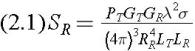
In free space, the signal received from a target by the radar receiver can be expressed as [1]
where:
S R = signal power at radar receiver (W)
P T = transmitter power (W)
G T = gain of radar transmit antenna in the direction of the target
G R = gain of radar receive antenna in the direction of the target
? = wavelength (m)
? = target radar cross section (square meters)
R R = radar range to target (m)
L T = radar losses from transmitter to antenna
L R = radar losses from antenna to receiver
The received signal is inversely proportional to the range to the target to the fourth power because the signal undergoes spreading on the way to the target and again on the way back from the target.