ELINT: The Interception and Analysis of Radar Signals

Charles Estrella
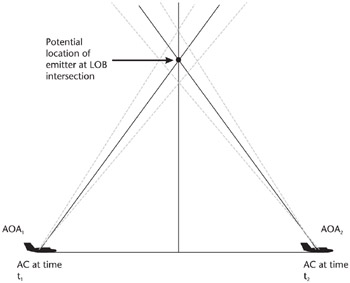
The capability of performing accurate emitter location has become a primary requirement for today s reconnaissance platforms. In practice, one or more platforms can be used to perform geolocation using emitter bearing, time, and/or frequency information. A single platform can use pulse angle of arrival information to form lines of bearing (LOBs) along which the emitter lies. The intersections of the LOBs provide a location estimate, as shown in Figure 6.1.
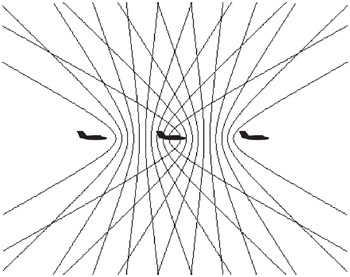
With multiple platforms, measurements of an emitter s time of arrival from one platform can be used with TOA measurements from another to compute a time difference of arrival. Each TDOA forms a hyperbola, or isochrone, upon the surface of the Earth. An intersection of TDOA isochrones provides a potential location of the emitter. An example of isochrones for various values of TDOA between three aircraft is shown in Figure 6.2.
Frequency difference of arrival (FDOA) measurements can be made in conjunction with TDOA measurements by determining the peak of the complex ambiguity function (CAF) between two intercepts from moving platforms [1]. In this case, the intersection of isochrones and iso-Doppler lines as shown in Figure 6.3 provide location estimates of the emitter.
Because of uncertainties in TDOA, FDOA, and AOA measurements, uncertainties exist in the estimated emitter location. An estimate of uncertainties in emitter location...