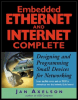
Embedded Ethernet and Internet Complete: Designing and Programming Small Devices for Networking
Chapter 5 showed how to use TCP and UDP to exchange messages containing application-specific data. Many standard application-level protocols also use TCP or UDP when exchanging information. One of the most popular of these is the hypertext transfer protocol (HTTP), which enables a computer to serve Web pages on request.
Because embedded systems almost always serve Web pages that contain dynamic, or real-time, information, this chapter begins with Rabbit and TINI examples that serve Web pages with dynamic content. Following the examples is an introduction to using HTTP and other protocols in serving Web pages.
A Web browser such as Microsoft s Internet Explorer is a client application that uses HTTP to request Web pages from servers on the Internet or in a local network. The servers don t have to be PCs or other large computers. Even a small embedded system with limited memory can serve a page containing text and simple images, including pages that display real-time data and accept and act on user input.
A browser provides a user interface for requesting and displaying pages. The computers that request Web pages typically have full-screen displays, but for some applications, an embedded system with limited display capabilities can function as an HTTP client. If the requested pages are very simple, even a text-only display of a few lines might suffice. Or an embedded system might receive and process the contents of a Web page without displaying the page in a browser at all.
This chapter focuses...