The Engineering Guide to LEED: New Construction: Sustainable Construction for Engineers

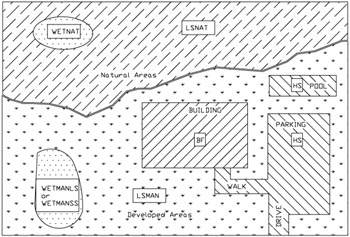
Many of the Sustainable Sites credits relate to the site land area and the areas within the sites that are developed or not developed in certain ways (see Figure 2.0.1). To understand this better, it is helpful to define the various portions of the site. Definitions as given by LEED-NC 2.2 for many of these site areas are given in App. B.
Let the following symbols represent the various areas of a site:
| A T | Total area of the lot (also referred to as the total project site area) |
| BF | Building footprint the planar projection of the built structures onto the land |
| DF | Development footprint total building and hardscape areas |
| EQR | Total roof areas that are covered by equipment and/or solar appurtenances and other appurtenances |
| HS | Hardscape: All nonbuilding manmade hard surface on the lot such as parking areas, walks, drives, and patios. Hardpacked areas such as gravel parking areas are included. Pools, fountains, and similar water-covered areas are included if they are on impervious surfaces which can be exposed when the water is emptied. |
| LSMAN | Manmade or graded landscaped area totals |
| LSNAT | Natural landscaped area totals |
| OS | Open space all natural areas and landscaped areas, also wet areas with vegetated low slopes |
| PD | Previously developed all areas that have been built upon, landscaped, or graded (not including areas that may have been farmed in centuries past and have returned to natural vegetation) |
| TR | Total roof area defined as the sum... |