Environmental Monitoring Handbook
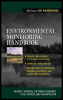
This handbook helps you with the most pervasive activity in environmental science --taking and analyzing environmental samples from water, air or soil.
 TABLE OF CONTENTS
 Ulrich F rstner
Soils and sediments are repositories for physical and biological debris and sinks for a wide variety of chemicals. The concern associated with the chemicals sorbed to sediments and soils is that many commercial species and food-chain organisms spend a major portion of their life cycle living in or on aquatic sediments or on contaminated soil. This provides a pathway for these chemicals to be consumed by higher aquatic or terrestrial life and wildlife, as well as humans. Direct transfer of chemicals from soils and sediments to organisms is now considered to be a major route of exposure for many species. These issues are focusing attention on soil and sediment contamination and highlight the fact that sediments are also an important resource (Adams et al., 1992).
Due to the capacity of soils and sediments to store and immobilize toxic chemicals in so-called chemical sinks, the effects of pollution may not be manifested directly. This positive function of soils and sediments does not guarantee, however, that the chemicals are stored safely forever. Factors influencing the storage capacity of soils and sediments or the bioavailablity of the stored chemical can change and indirectly cause sudden...