Fiber Optics Installer and Technician Guide

Optical fibers are called on to operate in a wide variety of conditions. Some of them must carry high volumes of data over many kilometers, while others carry smaller amounts of data inside an office building or aboard a ship. The type of job an optical fiber will do determines the type of fiber you'll choose to run. It is important to understand the types of fibers that are available and the ways in which they are built so that you can select and use them properly.
This chapter describes the construction of optical fibers and the components that make them up. We will discuss some of the important factors that must be considered in the manufacture and use of optical fibers, as well as the designs used to optimize them for different types of data transmission. Finally, the chapter will introduce you to some of the commonly used commercial optical fibers and describe their features.
Today's standard optical fiber is the product of precision manufacturing techniques and exacting standards. Make no mistake: even though it is found in almost any data or communications link, optical fiber is a finely tuned instrument requiring care in its production, handling, and installation.
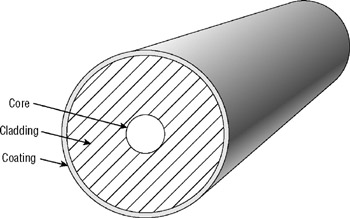
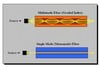
As shown in Figure 4.1, a typical optical fiber comprises three main components: the core, which carries the light; the cladding, which surrounds the core with a lower refractive index and contains the light; and the coating, which protects the fragile fiber within.