Fiber Optics Installer and Technician Guide

The objective of this chapter is to allow the reader to gain an understanding of fiber optic passive components and multiplexers. This chapter covers not only particular devices and their applications, but also the reasons why the components were chosen and when they should be used.
Fiber optic passive components and multiplexers are elementary items, but necessary in all applications that require the transmission, combining, or distribution of optical signals. Passive components are components that do not require an external energy source. Multiplexers are devices that are used to combine two or more signals into a single output. The term multiplexing is used to refer to the process by which the signals are combined.
Some of the optical devices we cover in this chapter are couplers, switches, attenuators, isolators, amplifiers, and filters. We will also examine multiplexers and their associated processes, in particular wavelength division multiplexing and dense wavelength division multiplexing.
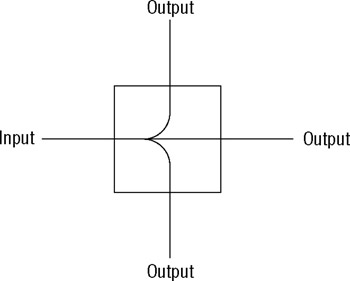
In many applications, it may not be possible to have a design of many point-to-point connections. In these cases, optical couplers are used. A fiber optic coupler is a device that combines or splits optical signals. A coupling device may combine two or more optical signals into a single output, or the coupler may be used to take a single optical input and distribute it to two or more separate outputs. Figure 12.1 is an example of a basic four-port coupler.
Couplers are available...