Finite Element Methods for Structures with Large Stochastic Variations
In the previous section we examined the FEM for stochastic structures based on the direct exact inverse of the global stiffness matrix. However, except for some simple cases, such as bar extension problems, the inverse of the global stiffness matrix is usually unobtainable. The FEM for stochastic problems based on the direct inverse cannot be generalized for wide application. In this section we apply the idea proposed by Fuchs (1991, 1992) to construct the element stiffness matrix and explicitly obtain the inverse of the global stiffness matrix for the beam bending problem.
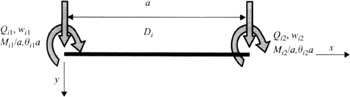
A straight beam element of uniform cross-section is shown in Fig. 3.4. Following the usual FEM notation, the element number i has a constant stiffness D i and length a. The element has two degrees of freedom at each end (nodal points): a transverse deflection w and an angle of rotation or slope ?. Corresponding to these degrees of freedom, a transverse shear force Q and a bending moment M, respectively, act at each nodal point. The shape function of this element is given by (Fried 1979).
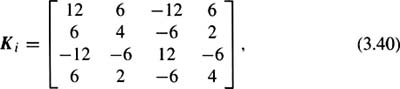
Since it is assumed that the finite element mesh is uniform, i.e. all elements have the same length a, the stiffness matrix can be written
where
where D i is the unknown parameter associated with element