Fundamentals of Instrumentation and Measurement
Chapter written by Bernard JOURNET and St phane POUJOULY.
In general, studying a physical phenomenon is done with a computerized system and a central computer guiding a range of measurement devices. Each of these devices is connected to a type of sensor, as well as to one or more buses for the exchange of information. Between the operator and the computer is the user interface. The idea of a measuring device should be understood in a broad sense, whether the device exists separately (battery or mains operated) or is part of a measurement card in a rack or a computer. In this chapter, our goal is to present an overall view of the principle measurement instruments, their functioning principles and the kinds of measurement that can be obtained by using them. Then connecting buses will be discussed, as well as ways to create a measurement chain; that is, an instrumentation system.
In this section, we will discuss standard measurement devices and their recent, digital, developments. Recently digitization is done throughout the system before the overall measurement process begins. This means it is carried out increasingly with sensors.
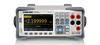
Generally speaking, a multimeter links a voltmeter, an amperemeter and an ohmeter. We limit ourselves to these three kinds of measurement because they can be organized easily around the same unit: the analog-to-digital converter (ADC). The three measurements listed above are often based on the numerization of one voltage. The measurement results are converted and displayed...