Gas Volume Requirements for Underbalanced Drilling: Deviated Holes

Several criteria and methods for determining the minimum gas volume requirement have been used in the gas drilling industry. They fall into two categories: (1) minimum kinetic energy and (2) minimum velocity.
The mixture of gas and solid is treated as one homogeneous phase with mixture density and velocity i.e., interactions between particles and fluids are not considered. Several models have been presented, including those given by Martin,1 ,2 Scott,3 Angel,4 and McCray and Cole.5 Although McCray and Cole's model permits a constant-percentage slip velocity of solid particles, it uses the same particle lift criterion as Angel's model.
The criterion for the minimum volume requirement is based on the experience gained from quarry drilling with air. The minimum annular velocity to effectively remove solid particles from the borehole is usually assumed to be 3,000 ft/min, or 50 ft/sec (fps), under atmospheric conditions (close to standard condition of 14.7 psia at 60 F). This velocity is believed to be high enough to remove dustlike particles in air drilling. Although big cuttings not removed from the vicinity of the bit by the circulating air are reground by the bit teeth, it would be uneconomical to lift large cuttings without first trying to control their initial size at the bit.
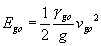
The carrying power of air with velocity of 50 fps can be evaluated based on its kinetic energy E o per unit volume of air:
| (2.1) | |
where
| ? go = | 0.0765... |