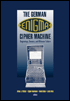
The German Enigma Cipher Machine: Beginnings, Success, and Ultimate Failure
ALAN TURING: THE ENIGMA

Ralph Erskine

Alan Turing: The Enigma, by Andrew Hodges. London: Burnett Books, 1983. 18.00. New York: Simon and Schuster. $22.50. 587 pp. 8(4): 332 336.

The title, of course, holds the key - and not only for readers of this journal. Alan Turing worked at the United Kingdom's Government Code and Cypher School ("GC&CS") at Bletchley Park in World War II, mainly on cracking Enigma. He was also a fascinating, and complex, person. He played a major part in designing the British electro-mechanical bombes, which were used to ascertain the key settings of Enigma machines by the probable word method, a task for which his talents and prewar research made him almost uniquely qualified [1]. It was a massive stroke of good fortune for GC&CS and his country that, while at Princeton in 1938, he declined the offer of a post as assistant to John von Neumann unless, as seems unlikely, he had been approached by GC&CS before his departure for America in 1936. However, Bletchley was only a small part of Turing's life, notwithstanding that it was vital to the Allied cause. He was, first and foremost, an applied mathematician of genius and a profoundly original thinker in the fields of computers and machine intelligence.

This review concentrates on the author's treatment of Turing's work at GC&CS (pages 160 to 314). One reviewer has commented that "Andrew Hodges' account of the mathematical, logical and engineering work in the whole Enigma story is, perhaps, the...

UNLIMITED FREE
ACCESS
TO THE WORLD'S BEST IDEAS

SUBMIT
Already a GlobalSpec user? Log in.

This is embarrasing...

An error occurred while processing the form. Please try again in a few minutes.

Customize Your GlobalSpec Experience

Category: High Speed Cameras
Finish!
Privacy Policy

This is embarrasing...

An error occurred while processing the form. Please try again in a few minutes.