Gigahertz and Terahertz: Technologies for Broadband Communications

Concise 30,000 foot view of wireless and fiber-optic broadband
communications technologies.
 TABLE OF CONTENTS
 In almost every respect the telecommunications scene repeatedly experiences revolutionary change. Many people are too young to remember Strowger exchanges, regularly crossed lines, and calls often failing to connect. Yet this was the case as recently as the 1980s even in many developed countries. For anyone living in an early-stage developing economy the introduction of the basic telephone and plain old telephone service (or POTS) is, of course, a major event which promises to transform lives and businesses.
The introduction of digital electronic exchanges, fiber-optic transmission, and satellite communications changed the scene radically. By the late twentieth century crossed lines had become a rare event in advanced economies and all callers expected their connections to be made the first time and to stay connected until hanging up even at three cents per minute. Mobile phone use had grown almost exponentially and some people sported dummy phones so they would look really streetwise in spite of the fact they could not afford to use the real thing!
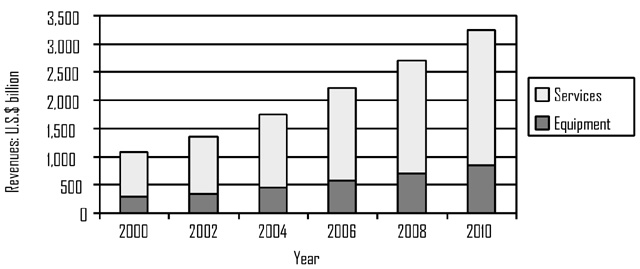
Total global telecommunications industry revenues, services, and equipment broke through the trillion dollar level in 1998 and (even allowing for the modest amount of Y2K disruption in year 2000) will approach $3.2 trillion by 2010. The overall trend is shown in Figure 1.1. Service revenues are always well ahead of equipment sales witness the fact that mobile phones and PCs are often offered free of charge because the payback from the service side dominates so greatly.