Global Methods for Combinatorial Isoperimetric Problems
With a focus on global methods, this innovative text employs morphisms to transform new problems into more restricted and easily solvable settings while preserving essential structure.
 TABLE OF CONTENTS
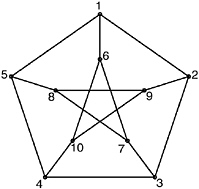
Denote by P the Petersen graph (diagrammed in Fig. 6.1 ). The Petersen graph is a favorite with combinatorialists because of its unusual and extremal properties. It has the reputation of being a universal counterexample, the rock upon which many a pretty conjecture has foundered. It is the logo of the Journal of Graph Theory and there is even a book devoted to its lore [55].
Let P d = P P P, the d-fold product of Petersen graphs. Bezrukov, Els sser & Das [18], motivated by computer scientists interested in using P d as the connection graph for multiprocessing computers, solved the EIP for P d. Their solution and proof, which we now turn to, is a beautiful illustration of the power of compression and may well point the way for future developments.
The Petersen graph has nested solutions, maximizing E ( S) , the number of induced edges, over all S ? V with S = k. The initial segments of the numbering,  1 , shown in Fig. 6.1 are such optimal sets.
Proof P has girth (the minimum length of a circuit) of 5. Thus for 0 ? k < 5 , solution sets induce trees, and for k =...