Global Methods for Combinatorial Isoperimetric Problems
With a focus on global methods, this innovative text employs morphisms to transform new problems into more restricted and easily solvable settings while preserving essential structure.
 TABLE OF CONTENTS
The failure of compression, or any combinatorial alternative, to solve the EIP on  or the VIP on
 , ultimately forced combinatorialists back to the old workhorse of classical mathematics: calculus. By this we mean passing to a continuous limit, solving the continuous problem by variational means and arguing that the essence of the combinatorial problem is preserved in the limit.
If we let n 1 = n 2 = = n d = n ? ? , then 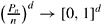 , the d-dimensional unit cube. Given any ideal, S ? [0, 1] d, with the product partial order, then
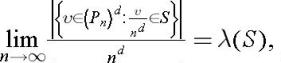
the ( d-dimensional) Lebesgue measure of S. Also, if ? ( S) is the area of the free boundary of S (that part of the boundary of S in the interior of [0, 1] d), measured wrt the L 1 (taxicab) metric, then
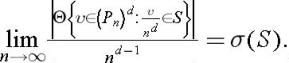
Thus the analog of the EIP on [0, 1] d is, given v ? [0, 1], to minimize ? ( S) over all ideals S ? [0, 1] d such that ? ( S) = v. We claim that the only critical (locally optimal) stable ideals for the EIP on [0, 1] d are S ( j, d, t) = [0, 1] d ? j [0, t] j, 1 ? j