GPRS: General Packet Radio Service

Written by telecom expert R.J. "Bud" Bates, this straightforward, abundantly illustrated text reveals GPRS s features, functions, and architecture--information crucial whether you re providing or applying GPRS.
 TABLE OF CONTENTS
 This chapter focuses on the radio interface (the interface between the mobile station (MS) and the Base Transceiver System (BTS), which is functionally the Global System for Mobile Radio Frequency [GSM RF] layer) and on the mobile station to the packet control unit (PCU) interface, which is the Radio Link Control/Medium Access Control layers (RLC/MAC layer).
To start the whole process off, the radio interface corresponds to the software in Layer 1 (GSM RF layer) between the mobile station and the BTS using the OSI model as the base reference, which is shown in Figure 6-1. The GSM RF layer manages the physical link between the mobile station and the Base Station Subsystem (BSS) (the combined BTS and BSC). This layer corresponds physically to the Channel Codec Unit (CCU) inside the BTS. Sometimes the reference materials show this layer divided into two sublayers, including the
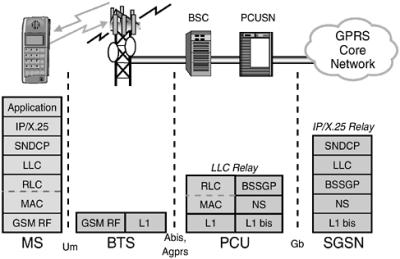
Physical RF layer The physical RF layer corresponds to the modulation and demodulation tasks, similar to GSM current techniques (GMSK modulation and Viterbi demodulation), but plans call for this to change in further evolutions of GPRS with the introduction of a more spectrum-efficient modulation ( Enhanced Data rates for GSM Evolution [EDGE]).
Physical link layer The physical link layer provides information transfer over a physical channel on the radio interface. It provides channel-coding...