A Guide to MATLAB for Beginners and Experienced Users

Numerical Solution of the Heat Equation

In this section we will use MATLAB to numerically solve the heat equation (also known as the diffusion equation), a partial differential equation that describes many physical processes including conductive heat flow or the diffusion of an impurity in a motionless fluid. You can picture the process of diffusion as a drop of dye spreading in a glass of water. (To a certain extent you could also picture cream in a cup of coffee, but in that case the mixing is generally complicated by the fluid motion caused by pouring the cream into the coffee and is further accelerated by stirring the coffee.) The dye consists of a large number of individual particles, each of which repeatedly bounces off of the surrounding water molecules, following an essentially random path. There are so many dye particles that their individual random motions form an essentially deterministic overall pattern as the dye spreads evenly in all directions (we ignore here the possible effect of gravity). In a similar way, you can imagine heat energy spreading through random interactions of nearby particles.

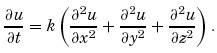
In a three-dimensional medium, the heat equation is

Here u is a function of t, x, y, and z that represents the temperature, or concentration of impurity in the case of diffusion, at time t at position ( x, y, z) in the medium. The constant k depends on the materials involved; it is called the thermal conductivity

UNLIMITED FREE
ACCESS
TO THE WORLD'S BEST IDEAS

SUBMIT
Already a GlobalSpec user? Log in.

This is embarrasing...

An error occurred while processing the form. Please try again in a few minutes.

Customize Your GlobalSpec Experience

Category: Dye Lasers
Finish!
Privacy Policy

This is embarrasing...

An error occurred while processing the form. Please try again in a few minutes.