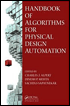
Handbook of Algorithms for Physical Design Automation
Part II: Foundations

CHAPTER LIST

Chapter 4: Basic Data Structures
Chapter 5: Basic Algorithmic Techniques
Chapter 6: Optimization Techniques for Circuit Design Applications
Chapter 7: Partitioning and Clustering

Dinesh P. Mehta and Hai Zhou

4.1 INTRODUCTION

Physical design automation may be viewed as the process of converting a circuit into a geometric layout. We distinguish between three categories of data structures for the purpose of organizing this chapter:

  1. Data structures used to represent the input to physical design: the circuit or the netlist

  2. Data structures used during the physical design process

  3. Data structures used to represent the output of physical design: the layout

4.2 INPUT DATA STRUCTURES

A circuit consists of components and their interconnections. Each component contains logic that implements some functionality. It also has pins (or terminals) with which it communicates with other components. The entire circuit also needs to be able to communicate with the rest of the world and does so through the use of external pins. An interconnection connects (or makes electrically equivalent) a set of two or more pins. These pins may be associated with the components or may be external pins. Each interconnection is called a net. The circuit is described by a list of all nets, the netlist. Figure 4.1 shows a simple example, where the components are simple logic gates. Components do not necessarily have to be logic gates. A component could be more complex. For example, it could be a multiplier that was manually designed...

UNLIMITED FREE
ACCESS
TO THE WORLD'S BEST IDEAS

SUBMIT
Already a GlobalSpec user? Log in.

This is embarrasing...

An error occurred while processing the form. Please try again in a few minutes.

Customize Your GlobalSpec Experience

Category: Automated Test Equipment
Finish!
Privacy Policy

This is embarrasing...

An error occurred while processing the form. Please try again in a few minutes.