Handbook of Structural Welding: Processes, Materials and Methods Used in the Welding of Major Structures, Pipelines and Process Plant

Special welding problems associated with individual processes

Ammonia

Problem area

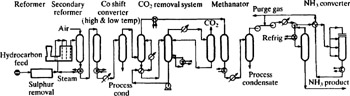
Figure 5.53 is a process flow diagram for a high output single train ammonia plant. [33] The hydrocarbon feed (usually methane) is desulphurised and passes through reformer tubes where, mixed with steam, it is converted to a mixture of hydrocarbon, CO, CO 2 and hydrogen. Air is injected in the secondary reformer, to add nitrogen and convert CO to CO 2. The CO 2 is then absorbed and a hydrogen plus nitrogen synthesis gas is formed. This passes over a catalyst in the converter to form ammonia which goes to storage.


Figure 5.53: Process flow diagram for a single train Kellogg low pressure ammonia synthesis unit. [33]

For welding, the chief areas of concern are the primary reformer, the ammonia converter and the storage containers, particularly those operating at or near to room temperature. Problems with the converter do not differ significantly from those of heavy-wall pressure vessels in general, as discussed earlier.

Reformer furnace

A top-fired furnace with catalyst tubes welded directly to the outlet manifold is shown in Fig. 5.54. Furnaces may also be bottom or side-fired, and the catalyst tube is often attached to the outlet manifold via a pigtail. This is a short length of wrought Incoloy 800 tube which can flex to accommodate movements due to expansion. Typical operating conditions are: pressure 400 500 psi (2.75 3.4 N/mm 2) and temperature 1275 F (670 C) at the inlet and 1600 F (870...

UNLIMITED FREE
ACCESS
TO THE WORLD'S BEST IDEAS

SUBMIT
Already a GlobalSpec user? Log in.

This is embarrasing...

An error occurred while processing the form. Please try again in a few minutes.

Customize Your GlobalSpec Experience

Category: Industrial Gases
Finish!
Privacy Policy

This is embarrasing...

An error occurred while processing the form. Please try again in a few minutes.