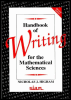
Handbook of Writing for the Mathematical Sciences, 2nd Edition
Chapter 3: Mathematical Writing

Suppose you want to teach the "cat" concept to a very young child. Do you explain that a cat is a relatively small, primarily carnivorous mammal with retractile claws, a distinctive sonic output, etc.? I'll bet not. You probably show the kid a lot of different cats, saying "kitty" each time, until it gets the idea. To put it more generally, generalizations are best made by abstraction from experience.

RALPH P. BOAS, Can We Make Mathematics Intelligible? (1981)

A good notation should be unambiguous, pregnant, easy to remember; it should avoid harmful second meanings, and take advantage of useful second meanings; the order and connection of signs should suggest the order and connection of things.

GEORGE POLYA, How to Solve It (1957)

We have not succeeded in finding or constructing a definition which starts out "A Bravais lattice is "; the sources we have looked at say "That was a Bravais lattice."

CHARLES KITTEL, Introduction to Solid State Physics (1971)

Notation is everything.

CHARLES F. VAN LOAN, FFTs and the Sparse Factorization Idea (1992)

Overview

The mathematical writer needs to be aware of a number of matters specific to mathematical writing, ranging from general issues, such as choice of notation, to particular details, such as how to punctuate mathematical expressions. In this chapter I begin by discussing some of the general issues and then move on to specifics.

3.1 What Is a Theorem?

What are the differences between theorems, lemmas, and...

UNLIMITED FREE
ACCESS
TO THE WORLD'S BEST IDEAS

SUBMIT
Already a GlobalSpec user? Log in.

This is embarrasing...

An error occurred while processing the form. Please try again in a few minutes.

Customize Your GlobalSpec Experience

Category: Coiled Cords and Cables
Finish!
Privacy Policy

This is embarrasing...

An error occurred while processing the form. Please try again in a few minutes.