Hard Disk Drive Servo Systems, 2nd Edition
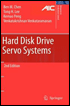
Reflecting recent improvements in spindle speed, bit density, and other changes in this fast-moving field, this monograph focuses on the applications of some newly developed results in control theory.
Every physical system in real life has nonlinearities and very little can be done to overcome them. Many practical systems are sufficiently nonlinear so that important features of their performance may be completely overlooked if they are analyzed and designed through linear techniques. In HDD servo systems, major nonlinearities are frictions, high-frequency mechanical resonances and actuator saturation nonlinearities. Among all these, the actuator saturation could be the most significant nonlinear-ity in designing an HDD servo system. When the actuator saturates, the performance of the control system designed will seriously deteriorate. Interested readers are referred to a recent monograph by Hu and Lin [123] for a fairly complete coverage of many newly developed results on control systems with actuator nonlinearities.
The actuator saturation in the HDD has seriously limited the performance of its overall servo system, especially in the track-seeking stage, in which the HDD R/W head is required to move over a wide range of tracks. It will be obvious in the forthcoming chapters that it is impossible to design a pure linear controller that would achieve a desired performance in the track-seeking stage. Instead, we have no choice but to utilize some sophisticated nonlinear control techniques in the design. The most popular nonlinear control technique used in the design of HDD servo systems is the so-called proximate time-optimal servomechanism (PTOS) proposed by Workman [30], which achieves near time-optimal performance for a large class of motion control systems characterized by a double integrator. The PTOS was actually modified...

 TABLE OF CONTENTS