Industrial Refrigeration Handbook

Chapter 6: EVAPORATORS AIR COILS AND LIQUID CHILLERS

6.1 WHERE THE REFRIGERATION LOAD ENTERS THE SYSTEM

The evaporator is the component of the refrigeration system where a fluid stream or a product is cooled. As Fig. 6.1 shows, the evaporator is the interface between the process and the refrigeration system. With the exception of direct cooling a product, such as in a plate freezer, most evaporators chill air or such liquids as water, brine, or antifreeze.


FIGURE 6.1: Cooling of a fluid stream at the evaporator.

6.2 TYPES OF EVAPORATORS

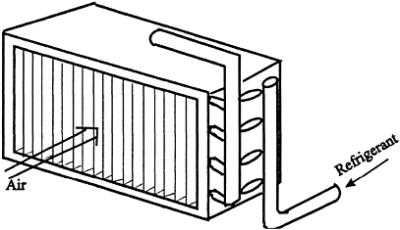
Two major categories of evaporators used in industrial refrigeration practice are air coils and liquid chillers. A typical air coil is shown in Fig. 6.2 and several types of liquid chillers are shown in Fig. 6.3. In the air coil, refrigerant flows through the tubes and air passes over the outside of the tubes. For effective heat transfer, fins are fastened to the outside of the tubes and the air flows between the fins.


FIGURE 6.2: An air cooling coil.

FIGURE 6.3: Liquid-chilling evaporators: (a) shell-and-tube with the refrigerant boiling in the shell, (b) shell-and-tube with the refrigerant boiling in the tubes, and (c) a plate-type evaporator.

The liquid-chilling evaporators in Figs. 6.3a and 6.3b are of the shell-and-tube design, while Figs. 6.3c is a plate-type chiller. In Fig. 6.3a the refrigerant boils in the shell while the liquid flows through the tubes. In Fig. 6.3b the roles of the tubes and shell are reversed. The plate-type evaporator in Fig. 6.3c is growing in market share...

UNLIMITED FREE
ACCESS
TO THE WORLD'S BEST IDEAS

SUBMIT
Already a GlobalSpec user? Log in.

This is embarrasing...

An error occurred while processing the form. Please try again in a few minutes.

Customize Your GlobalSpec Experience

Category: Chillers (industrial)
Finish!
Privacy Policy

This is embarrasing...

An error occurred while processing the form. Please try again in a few minutes.