Industrial Refrigeration Handbook

It is mandatory that refrigeration load calculations be performed during the design stage in order to properly size the components. Load calculations are useful on other occasions as well, such as to evaluate the effectiveness in conserving energy of a proposed plant modification. Still another situation where a load calculation may be useful or necessary is in troubleshooting, when, for example, a refrigerated space cannot be maintained at the design temperature or a production rate is lower than design.
Many designers use computer programs and/or checklists as aids in performing load calculations so that all the major sources are included. The most significant error in load calculations probably results from the complete omission of a contributor, in contrast to a 20 to 30% error in any one calculation. Using a computer program for the load calculation will inherently incorporate all the items if the program has been written properly in the first place. The major contributors to refrigeration loads are: (1) the heat transmission through the roof, floor, and walls (2) infiltration through open doorways (3) internal loads from lights, people, motors, and lift trucks (4) defrost heat and (5) the product load cooling, freezing, and maintaining the temperature of products. All of these categories will be addressed in this chapter.
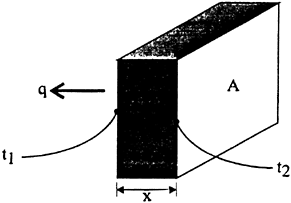
When heat flows by conduction through a wall, as in Fig. 18.1, the equation that expresses the rate...