Intelligent Agent-Based Operations Management

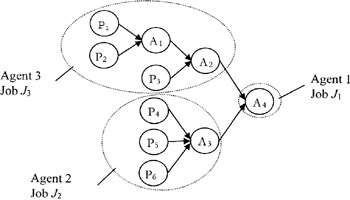
Consider a product to be produced in { m=2, q=1} manufacturing system. The assembly sequences of the product is shown in Figure 3. The machining and assembly times are provided in Table 2.
| Part | P 1 | P 2 | P 3 | P 4 | P 5 | P 6 |
|---|---|---|---|---|---|---|
| Machining Time | 6 | 4 | 6 | 1 | 6 | 9 |
| Assembly | A 1 | A 2 | A 3 | A 4 |
|
|
| Assembly Time | 3 | 4 | 3 | 5 |
|
|
To decompose the digraph, we remove the root node A 4. All the resulted subdigraphs have simple assembly structure. After decomposition, an agent is assigned to each job. The set of following jobs is defined: J={ J 1, J 2, J 3}.
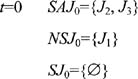
Initialise the system:

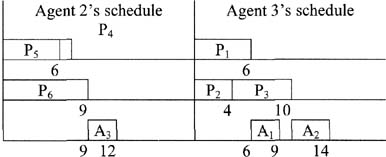
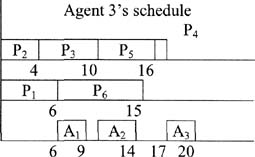
At this stage the schedule manager gives a signal to the agents of all the schedulable jobs to find the best possible schedule (shortest makespan) with the consideration of scheduled jobs (the set of scheduled jobs is empty at t=0). The Gantt charts of schedules obtained by individual agents having job in SAJ 0 are provided below.

Agent a 2 is the winner, since his schedule has the shortest makespan.
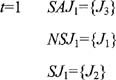
The system is updated as follows:

The Gantt chart of schedule obtained by the only agent having job in SAJ 1 is provided below.

Agent a 2 realises that...