Intelligent Agent-Based Operations Management
Producing customised products in a short time at low cost is one of the goals of agile manufacturing. To achieve this goal in a manufacturing system, products are differentiated either by a machining-driven or an assembly-driven differentiation strategy [HE 96]. The successful implementation of these two strategies lies in efficient scheduling of the system. To react fast to changes in the market, agile manufacturing demands its manufacturing operations be distributed, its manufacturing system be modular, interactive, and robust, and the scheduling problems be solved fast. Yet, most existing scheduling systems are developed based on centralised structures, which makes manufacturing systems scheduling complicated. The purpose of applying agent-based approach to solve scheduling problems is to make the scheduling system easier to design and implement, more robust and less prone to errors, easier to use, faster, cheaper, and so on.
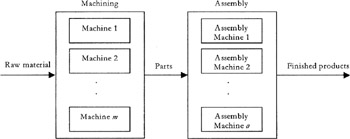
In this paper, agent-based approaches are applied to solve a complex scheduling problem in an agile manufacturing system. The structure of the manufacturing system that implements the product differentiation strategy in agile manufacturing is shown in Figure 1. It consists of two stages: machining and assembly, where there are m number of identical machines at the machining stage and q number of identical assembly machines at the assembly stage. The manufacturing system with this configuration is referred as {m, q} manufacturing system.