Intermediate Dynamics for Engineers: A Unified Treatment of Newton-Euler and Lagrangian Mechanics

In this chapter, the balance laws
and
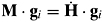
for a rigid body are discussed. Several component forms of these laws are considered. For instance, the components of the balance of angular momentum with respect to the corotational basis e i,
lead to a set of equations [(9.9)] that are known as Euler s equations. In a subsequent chapter, we shall show that
lead to Lagrange s equations.
Once the balance laws have been discussed, a brief outline is given of the work energy theorem, and it is shown how to establish energy conservation for a rigid body. Our attention then turns to applications. In particular, we discuss the dynamics of a body rotating about a fixed point, moment-free motion of a rigid body, rolling and sliding spheres, and the dynamics of baseballs and footballs. Several other applications are discussed in the exercises. Despite all these examples, our consideration of applications is far from exhaustive. At the conclusion of this chapter, some details are provided on some other interesting applications that have been modeled by use of a single rigid body.
Euler s laws for a rigid body can be viewed as extensions to Newton s second law for a single particle. There are two laws, or postulates, the balance of linear momentum and the balance of angular momentum:
Here, H O is the angular momentum of the rigid body relative to a fixed point O and M O