Intermediate Dynamics for Engineers: A Unified Treatment of Newton-Euler and Lagrangian Mechanics

In a famous paper [118] on the dynamics of the Moon orbiting the Earth, which was published in 1782, Lagrange used his equations of motion in the form
where V is the potential energy of the Moon and T is its kinetic energy. His interest lay in explaining oscillations (librations) in the attitude of the Moon as seen by an Earth-based observer. What is interesting is that he does not use Euler s balance laws, although these were available to him. One might ask what would have happened had he used
and
instead of (10.1)? In this chapter, we will show (among other matters) that his equations are equivalent to Euler s balance laws and so he would have arrived at the same conclusions.
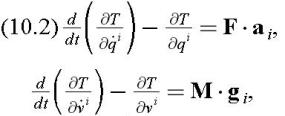
We start this chapter by showing that the balance laws
and
for a rigid body are equivalent to Lagrange s equations of motion:
We illustrate this form of Lagrange s equations by using a classical problem of a satellite orbiting a fixed body. Indeed, the problem we consider is equivalent to that considered by Lagrange [118].
A second form of Lagrange s equations of motion is also developed. This form allows broader classes of coordinate choices and, being the most general, is most useful in applications. The form of the celebrated equations is
where
Following the development of (10.3), we show how constraints may be incorporated and illustrate this matter by using examples of rolling disks, sliding disks, and spinning tops.
When the...