Introduction to Electronic Defense Systems, Second Edition
In this section only the concepts and formulas needed for an understanding of the subsequent discussion of weapon systems that exploit radiant energy will be reviewed. Most of the systems of interest based on the exploitation of radiant energy use the infrared (IR) band. That is why this particular band will receive special attention, although all the concepts relating to radiation from a body, and its detection, could be extended to visible and ultraviolet light. For a more detailed discussion, the interested reader should consult [48 50].
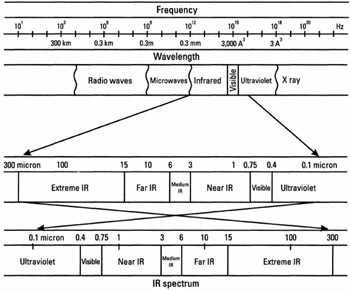
With reference to Table 2.3, of particular interest for this discussion is the portion of the IR spectrum characterized by atmospheric windows, that is, regions in which the atmosphere is transparent to radiation. The bands in which atmospheric windows exist are as follows:
Short-wave infrared (SWIR), characterized by wavelengths ? from 0.8 3.0m;
Medium-wave infrared (MWIR), characterized by wavelengths ? from 3 5m;
Long-wave infrared (LWIR), characterized by wavelengths ? from 8 12m.
|
![]() |
For a proper treatment of the topic, it is convenient to introduce the following standard definitions (Figure 2.105). The radiant flux P is defined to be the total energy radiated by a body in all directions in unit time, where P is total energy radiated in unit time. Radiant flux is measured in watts (W). Radiant flux per unit solid angle is denoted by J and is called radiant intensity:
| (2.124) |