7.1 Introduction
The electronic defense (ED) techniques and technologies currently in use have been amply treated in this book. The discussion in this chapter will center on the way in which traditional techniques evolve whenever technology provides designers with new, more powerful, and increasingly small devices.
This applies both to the analog-digital domain, with its silicon (Si) and gallium arsenide (GaAs) hybrid and semicustom circuits, and to the microwave domain, where the advent of monolithic microwave integrated circuits (MMIC), that is, monolithic GaAs circuits, makes possible the design of complex networks in minute volumes, totally unthinkable only a few years ago; see Figure 7.1 [1]. It applies also to software, where languages have been developed that permit the exploitation of artificial intelligence (AI) techniques for more reliable management and interpretation of data.
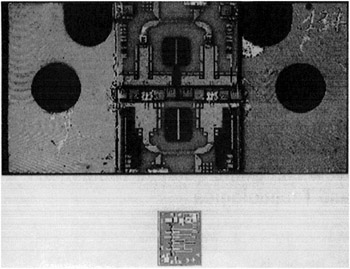 Figure 7.1: Comparison between an MIC and an MMIC in GaAs.
 This chapter will outline how the ED system architectures will change under the influence of the new technologies, especially that of digital processing (digital receiver) on the interception side and that of solid-state transmitters on the countermeasure side. After the assessment on microwave, digital, and IR technologies, the progress on shared apertures and what is foreseen on the direct energy weapon (RF) field will be discussed.
Possible countermeasures against the antiradiation missile (ARM) will be examined. Because of its hard-kill capabilities, this weapon will be considered as a threat rather than as an ECM.
Finally, new systems designed to counter the recent threat embodied in stealth aircraft...

 TABLE OF CONTENTS