Introduction to Numerical Analysis Using MATLAB

The differential equations are of fundamental importance in engineering mathematics because many physical laws of biology, chemistry, ecology, economics, business, and relations appear mathematically in the form of such equations.
In this chapter firstly we discuss first-order ordinary differential equations and sets of simultaneous first-order differential equations, since the nth-order differential equation may be solved by transforming it to a set of n-simultaneous first-order differential equations. All the specified conditions are on the same endpoints. These are initial-value problems. Many numerical methods are discussed for the approximate solutions of such initial value problems. In the end of the chapter we show how to approximate the solution to boundary-value prob lems, differential equations with conditions imposed at different points. For first-order differential equations, only one condition is specified, so there is no distinction between initial value and boundary value problems. We will also consider second-order equations with two boundary values.
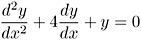
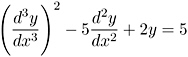
A differential equation is an equation involving functions and their derivatives. For example, the following equations
![]()
![]()
![]()

are differential equations.
For the sake of completeness, we shall define some of the standard terms for differential equations.
The variable that has been differentiated. For example, in each of the above differential equations (a)-(d), y is the dependent variable.
The variable with respect to which the differentiation is performed. For example, in each of the above differential equations (a)-(d), x is the independent variable.