An Introduction to Numerical Methods in C++, Revised Edition
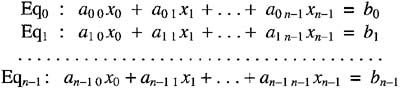
We now have the apparatus to consider how to compute the solution of linear equations in an arbitrary number of unknowns. We shall denote by the symbols Eq i the following set of n equations in n unknowns x i with constant real coefficients a ij:

The given coefficients form a square matrix A = ( a ij), and the unknowns x i, and the given right-hand constants b i are column vectors x and b, respectively. In matrix notation,
A very important quantity associated with a square matrix is its determinant. Presently, we shall see how to compute the determinant economically. For the time being we merely note that it may be defined recursively. Let A ( p,q) be the matrix obtained by striking out the pth row and the qth column of A. Then,
for any column j; or alternatively,
for any row i.
This is known as Cramer's rule. It should not be used to compute the determinants of matrices of more than a few rows and columns: it requires n! multiplications to evaluate the determinant of an n n matrix, which rapidly becomes prohibitive.
If A and B are n n matrices, then det( AB) = det( A)det( B). Note also that if A T is the transpose of A, obtained...