An Introduction to Numerical Methods in C++, Revised Edition
Computing speed is one thing; accuracy is another. We now have to try to estimate the errors involved in matrix operations. We shall need convenient and mutually consistent measures of magnitude of vectors and matrices which correspond to the modulus of a scalar quantity. We introduced the concept of a norm in Chapter 9. We must now formalize that concept, and learn how to apply it to matrix manipulation in order to estimate errors. The results we shall obtain will prove to be somewhat pessimistic, but they will serve at least to indicate situations where large errors are to be expected, and if possible avoided.
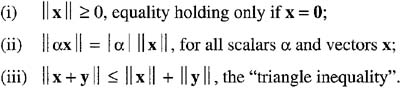
A vector norm ? x ? is a function of a vector x which has the following properties:

The last may also be written
and in the further form
which is known as the "reverse triangle inequality".
Note that all these properties are possessed by the length of a vector as usually defined in 2- or 3-dimensional euclidean space, namely the square root of the sum of the squares of its components. An appropriate generalization that also possesses these properties is
which reduces to the euclidean length when p = 2. There is no reason why p should be an integer, but the three most common norms are those having p = 1,2 and ?, the last being interpreted as the limit of ? x ? p as p ? ?. In these...