Ion Exchange Membranes: Preparation, Characterization, Modification and Application

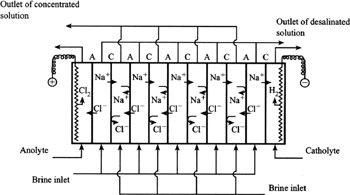
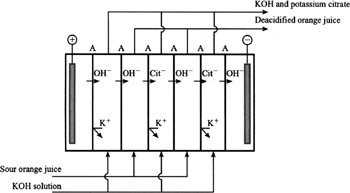
Electrodialysis is a process by which ionic substances with molecular weight below several hundreds permeate through a membrane in the presence of an electrochemical potential: to concentrate salt from dilute solution, to desalinate electrolytic solutions, to separate ionic from non-ionic substances, to ion exchange ions across a membrane, etc. Electrodialysis is generally carried out using a multi-compartment electrodialyzer, in which a plurality of ion exchange membranes is installed and the anode and cathode are placed at each end of the electrodialyzer. Figure 6.1 shows the principle of the concentration or desalination of an electrolyte solution by electrodialysis. The solution in alternate compartments is concentrated or desalinated in the presence of an electric current. The ion exchange reaction can be performed across the membrane by passing electric current using the same anion or cation exchange membranes (Figure 6.2). Figure 6.3 is an example of double decomposition of a neutral salt, in which four compartments are a unit in the electrodialyzer. Because a bipolar ion exchange membrane generates hydrogen ions and hydroxide ions by water splitting, acid and base are produced from neutral salt (Figure 6.4). Also, an ion exchange reaction can be efficiently achieved using the generated hydrogen ions and hydroxide ions across the membranes in the presence of electrical potential.