Ion Exchange Membranes: Preparation, Characterization, Modification and Application

6.4: Separation Based on Chemical Potential Difference (Concentration Gradient)

6.4 Separation Based on Chemical Potential Difference (Concentration Gradient)

Separation of electrolytes based on the difference in chemical potential across the ion exchange membrane can be classified into: (i) diffusion dialysis, (ii) Donnan dialysis, (iii) neutralization dialysis and (iv) up-hill transport. The natural flux of electrolytes through the membrane is low compared with that in the presence of an electrochemical potential.

6.4.1 Diffusion Dialysis

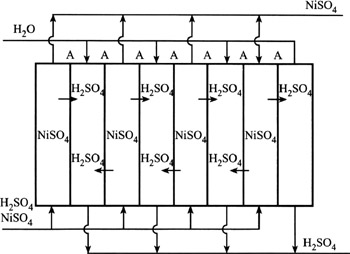
Diffusion dialysis was initially applied in viscose rayon production to recover caustic soda using parchment paper as a membrane. Today the largest industrial utilization of diffusion dialysis is to recover acids or alkalis from waste acids and alkalis using anion or cation exchange membranes. Figure 6.28 shows the principle of diffusion dialysis for acid recovery from waste acid solution. The process and membrane performance are evaluated on the basis of the flux of acids or alkalis (dialysis coefficient) and the ratio of the flux of metal salt to that of acids or alkalis (separation coefficient). The total dialysis coefficient [mol h ?1 m ?2 (mol 1 ?1)], U 0, is defined by


Figure 6.28: Recovery of acid from waste acid by diffusion dialysis. A: anion exchange membrane.

where ? m is the flux of acid or alkali and metal salt, A is the effective membrane area (m 2), ? ? is the concentration difference of electrolyte across the membrane (mol 1 ?1) and t is the period of diffusion dialysis (h).

UNLIMITED FREE
ACCESS
TO THE WORLD'S BEST IDEAS

SUBMIT
Already a GlobalSpec user? Log in.

This is embarrasing...

An error occurred while processing the form. Please try again in a few minutes.

Customize Your GlobalSpec Experience

Category: Dialysis Machines
Finish!
Privacy Policy

This is embarrasing...

An error occurred while processing the form. Please try again in a few minutes.