IP Location

The previous chapter dealt with the aspects of taking and providing network measurements inside the access network. It described the abstraction of the ALE and its role in taking network measurements and passing them to the Location Information Server (LIS) using FLAP. In this chapter, we examine the LIS in more detail. We describe the various LIS interfaces, the different types of LIS, and we discuss in some detail the HELD protocol and how it accommodates the location acquisition needs of various types of users.
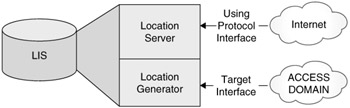
The Location Information Server (LIS) combines the functions of location determination and location distribution. The IETF GEOPRIV location architecture described in Reference 1, at the end of the chapter, describes two key functions, location determination performed by a location generator (LG), and location distribution performed by a location server (LS). These same two functions occur in the NENA-i2 and -i3 architectures but are combined into a single server called the LIS. Figure 4.1 shows how these two architectural views come together. For the remainder of this chapter, we shall restrict our terminology of this functionality to the term LIS.
The Location Information Server (LIS) is at the heart of the IP location architecture, and has the following key responsibilities:
Determining the location of an IP device inside its domain
Delivering location information to a Location Recipient
Asserting that the location provided by an IP device inside its domain is reasonable
Ensuring location dependability
Protecting...